
The Case for Red Runways
What if we could fundamentally reframe how pilots and drivers think about runways?
Sailors sometimes talk about the sea as if it were lava: if you fall overboard, you may as well assume you are dead unless you are quickly found and the recovery goes exactly right.
This mindset promotes careful behaviour onboard, minimising the likelihood of man-overboard incidents. Movements are slower, more planned and deliberate.
Pilots and drivers could adopt a similar mindset on the ground, treating the runway surface as a place where even small mistakes can have catastrophic consequences.
Colouring runway surfaces red is one way to reinforce that the moment you cross the holding point, you are in a zone that demands absolute respect. Lookout and listenout must be preserved, distractions mitigated and situational awareness optimised.
In the same way that coloured tennis courts or road surfaces focus attention and shape behaviour, a red runway could provide an immediate visual cue that you are about to enter, or have entered, the “lava zone,” especially helpful in low visibility or high‑workload phases of flight.
The Power of Visual Signals
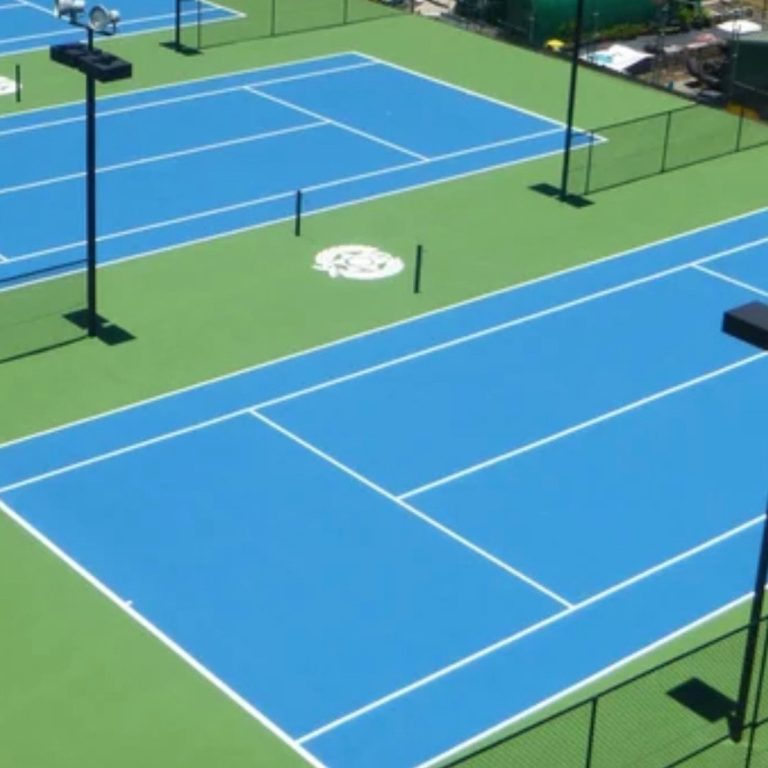
Tennis Courts
Coloured surfaces help players track ball movement and adjust positioning instantly, demonstrating how surface colour directly influences performance and decision-making.
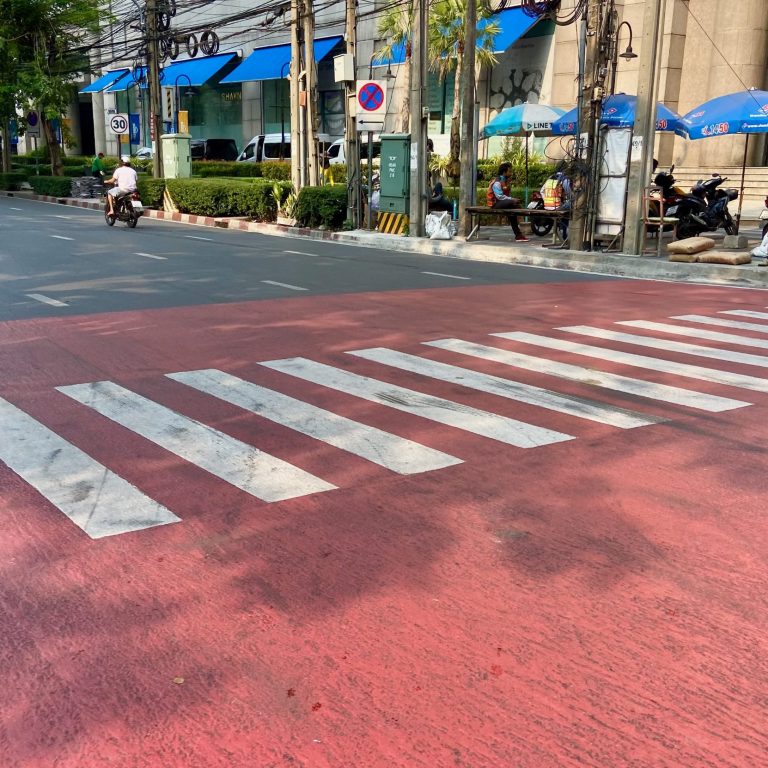
Road Markings
Cities worldwide use red pavement to designate high-priority zones such as bus lanes, pedestrian crossings and cycle paths with proven safety benefits.
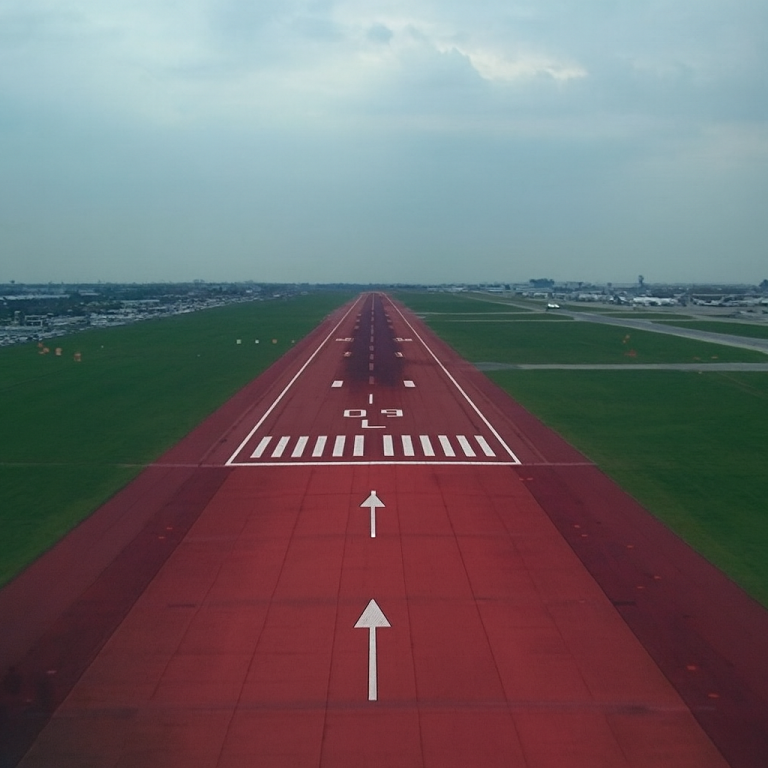
Runway Potential
A red runway could serve as a powerful visual signal, particularly valuable when situational awareness is unknowingly lost, in low-visibility conditions or when distraction is a threat.
Potential Safety Advantages
01
Enhanced Navigation Awareness
Red Surfaces could help pilots and drivers trap navigational errors before entering an active runway environment.
02
Conspicuous Boundaries
Hold points become more visually distinct, especially valuable during complex operations.
03
Low Visibility Conditions
Colour contrast may provide additional visual cues when fog, rain or darkness reduce situational awareness.
04
High Workload Support
During busy periods or in complex airport layouts, the red zone serves as a visual reminder, despite inevitable distraction.
05
Potential Take-Off Performance Benefits in Hot Weather
The reduced surface heat generated by an other-than-black runway surface has the potential to increase engine thrust on performance-limited runways in hot weather.
Critical Considerations
This non-exhaustive list details specific areas for detailed analysis in order to prove the concept and ensure safety benefits are realised.
01
Rigorous Testing Required
Any color change must undergo extensive evaluation to ensure it doesn't introduce unintended consequences, such as reduced friction coefficient or visual interference with existing safety systems.
02
Lighting System Integration
Red surfaces must work harmoniously with runway edge lights, centerline lighting, and approach lighting systems.
03
Compatibility with Markings
White and yellow runway markings must remain clearly visible against a red background across all lighting and weather conditions.
04
Approval and Standardization
Implementation would ultimately require coordination with ICAO and aviation authorities worldwide to ensure quality and consistency.
Defence In-Depth
Red runways are not proposed as a silver bullet solution. Runway safety requires multiple overlapping defenses, from technology to training to design.
Technology
Airport surface detection equipment (ASDE_X), Runway Status Lights and advanced ground radar.
Training
CRM, hotspot and other threat awareness, and complementary standardised procedures
Design
Innovative visual cues including surface color treatments.
The Path Forward
01
Research and Simulation
Conduct controlled studies using flight simulators to evaluate pilot response, visibility impacts, and potential benefits across various conditions.
02
Industry Collaboration
Engage airlines, pilot associations, airport operators, and regulatory bodies to refine the concept and address concerns.
03
Pilot Programme
Implement red runway surfaces at select airports with comprehensive monitoring, pilot feedback collection, and incident analysis.
04
Standardization
Develop international guidelines and best practices if testing demonstrates clear safety advantages.
Technical Considerations
Runway surfaces are typically constructed using hot-mix asphalt. That is, aggregates (crushed stone, sand, gravel) bound with bitumen laid in one or more layers. It is flexible, relatively quick to construct and repair, and provides a smooth, high-friction surface when grooved.
Many major or heavy-use runways use rigid concrete slabs (sometimes reinforced), made from cement, water and aggregates. Concrete offers very high load capacity and long life, but costs more and takes longer to build than asphalt.
Some runways combine a concrete base with an asphalt surface course to exploit concrete’s strength and asphalt’s smoother, more easily maintained wearing layer. In all cases, in is possible to add colour pigments without altering the longevity or friction characteristics of the surface.
Asphalt
Traditional paving asphalt is black, but asphalt surfaces can be produced in a wide range of colours. Coloured asphalt offers comparable mechanical performance to conventional mixes while providing a durable, visually distinctive surface. It is made from a clear (transparent) synthetic binder, mineral aggregates and added colour pigments. Because the binder contains no black pigment, the chosen colour appears much more vivid, even when relatively little pigment is used.
Concrete
To colour concrete runways without altering the friction characteristics of the original surface, there are two possible methods:
- Integral colour in the mix : Pigments (typically iron‑oxide) can be added directly into the fresh concrete so the colour is throughout the slab. This does not require a film on top, so the surface macro‑texture from brooming, tining, or exposed aggregate can be kept exactly as per the friction specification.
- Non‑film‑forming stains: Chemical or penetrating stains soak into the near‑surface paste without leaving a significant coating, so roughness and skid resistance remain largely governed by the original texture and aggregate.
A Case Study
At Chicago Midway airport, on February 25, 2025, Flexjet flight 560, a Bombardier Challenger 350 and Southwest Airlines flight 2504, a Boeing 737-800, were involved in a near miss incident. It was caused by a runway incursion and resulted in flight 2504 performing a go-around.
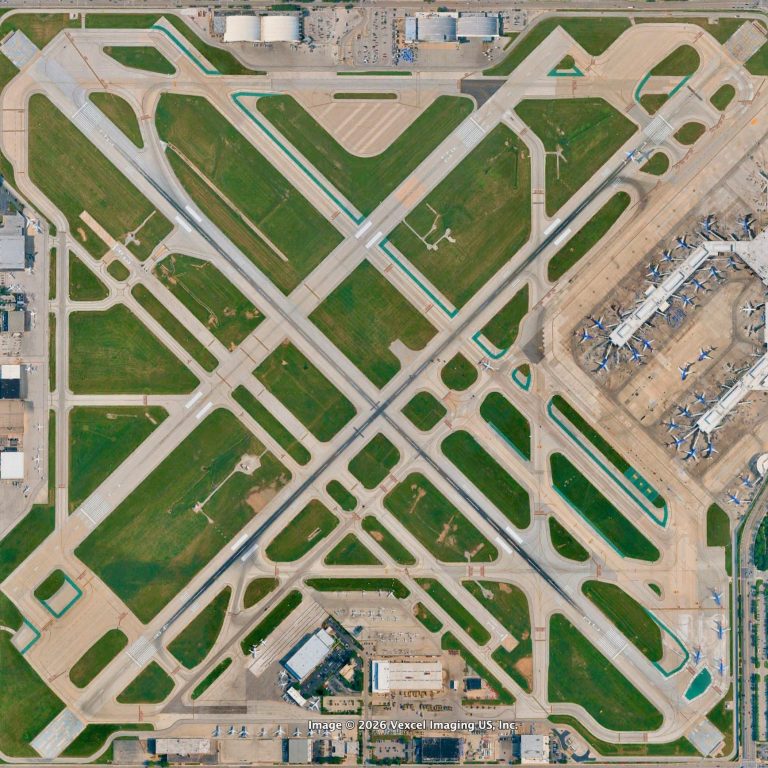
This is a plan view of Chicago Midway Airport (MDW). Can you identify all the runway surfaces?
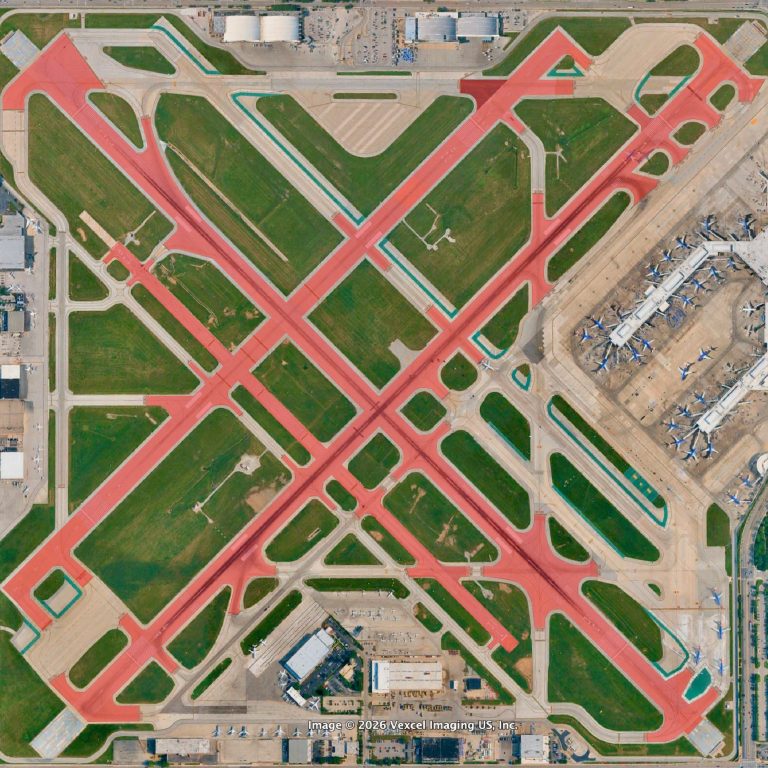
Here is the same plan view. The runways and holding points are coloured red. What is now easier to identify is runway 31L, a narrow (60' or 18m wide) runway that was mistaken for a taxiway by the flight crew. Taxiway H, formerly runway 31R, is now identifiable as a taxiway due to lack of colour.
Flight 560 had been cleared to cross runway 31L and hold short of runway 31C. However, the flight crew misidentified runway 31C, thinking it was runway 31L, and therefore crossed it.
Flight 2504 was in the landing flare on runway 31C as the incursion aircraft taxied across the runway.
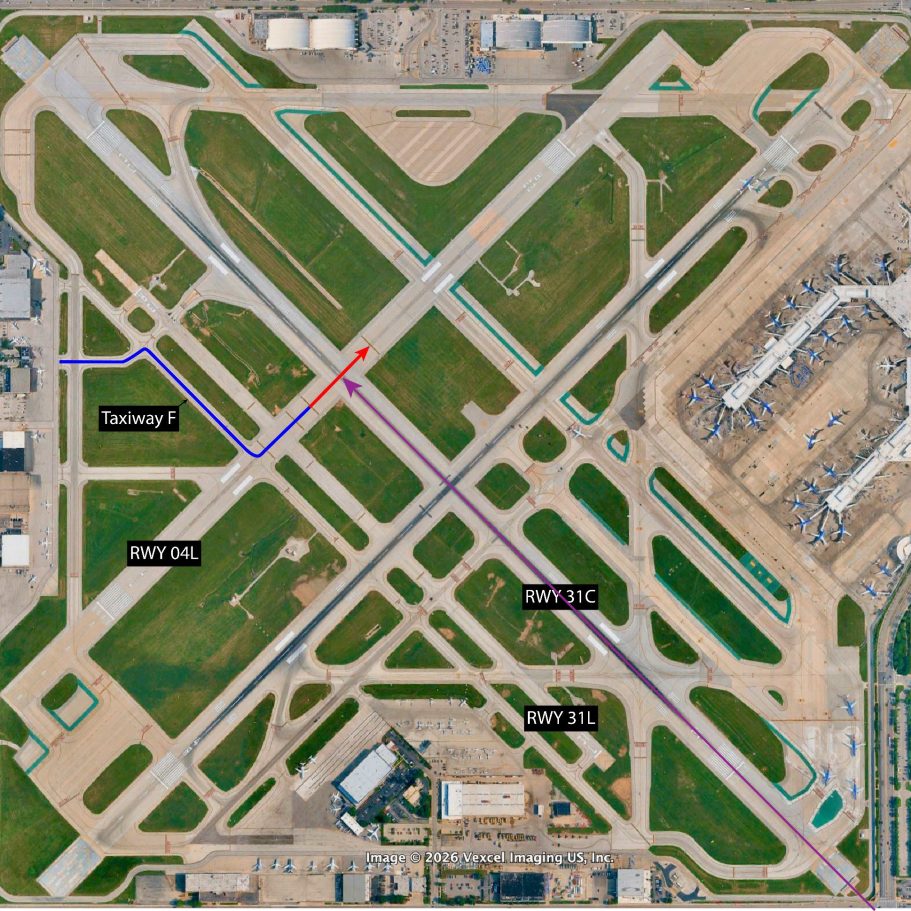
Plan view of Chicago Midway showing the cleared ground track of Flight 560 in blue, and the incursion in red. The landing aircraft, Flight 2504, is depicted in purple.
The preliminary report details how the Challenger flight crew recalled the sun was impeding visibility from the right side of the aircraft, however they did not recall seeing any hold short line/pavement markings or any other signs for the 31L intersection as they taxied onto runway 04L/22R.
They stated that taxiway F and runway 13R/31L were in close proximity to each other and by the time the nosewheel had straightened out, they were likely halfway across runway 13R/31L.
It is possible that had runway 31L been coloured red, it would have been more easily identified as a runway and not mistaken for a taxiway.
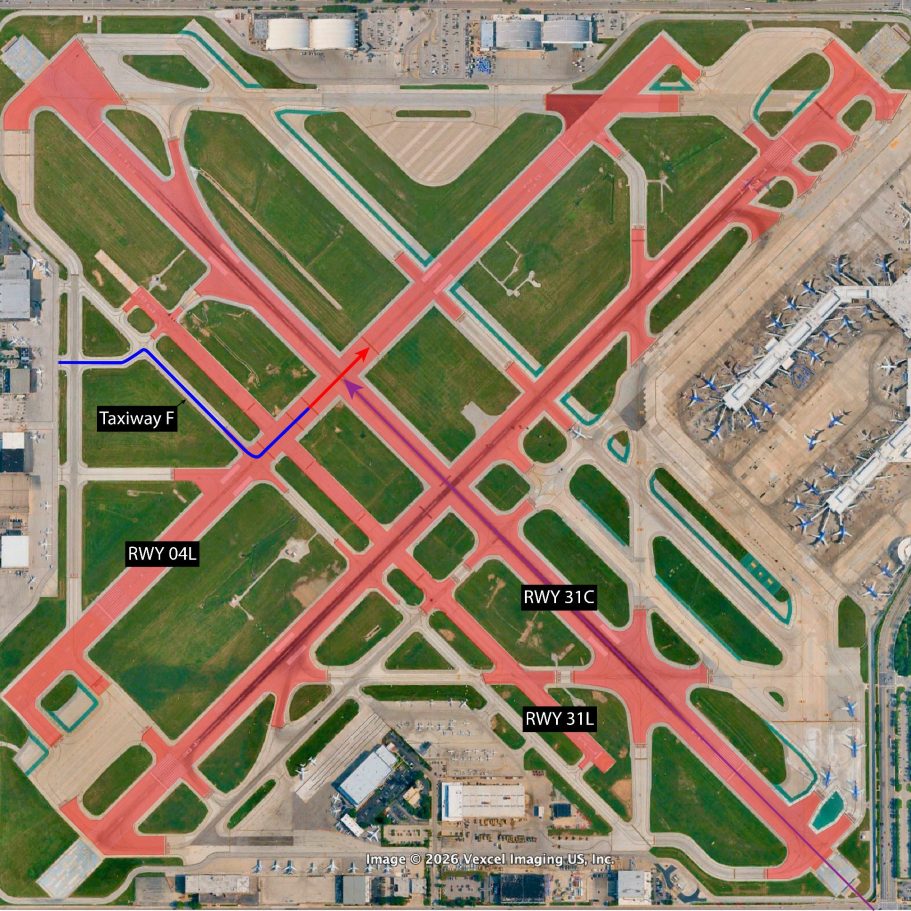
The same incursion event in which the runway surfaces have been coloured red. Despite its narrow width, runway 31L is coloured red therefore, must be a runway surface.
The above information is based on the preliminary report published by the NTSB in March 2025. There are clearly many more factors involved in this incident. For example, what was the focus of the flight crew at the time? Were they distracted? Why did they not check that the approach to runway 31C was clear before crossing the hold point? Were they under any time pressure? The list of questions goes on, so until the final report is published we cannot be sure. However, consider this: Is it possible that if the runway surfaces were coloured red, could that have been sufficient indication that they were crossing runway 31L shortly after turning onto runway 04L, and therefore they would have realised they were required to hold short of the next runway (31C)?
Moving Forward: Innovation in Aviation Safety
Red runways may seem unconventional, but aviation's greatest safety advances have often emerged from questioning established norms. From crew resource management to collision avoidance systems, transformative ideas began as proposals that challenged conventional thinking.
This concept invites aviation stakeholders—designers, regulators, airlines, and pilots—to explore whether colour can meaningfully contribute to runway safety. The potential rewards justify serious investigation through pilot studies, simulation testing, and collaborative research.
"Safety is not a destination but a journey of continuous improvement. Every innovation, no matter how simple, deserves consideration if it can save even one life."
Leave your feedback here. Name and email optional.
E-mail: info@mitchellaviation.com
Address: 71-75 Shelton Street, Covent Garden, London, WC2H 9JQ, United Kingdom